
A516 Grade 70 HIC Tested Plate Supplier in India
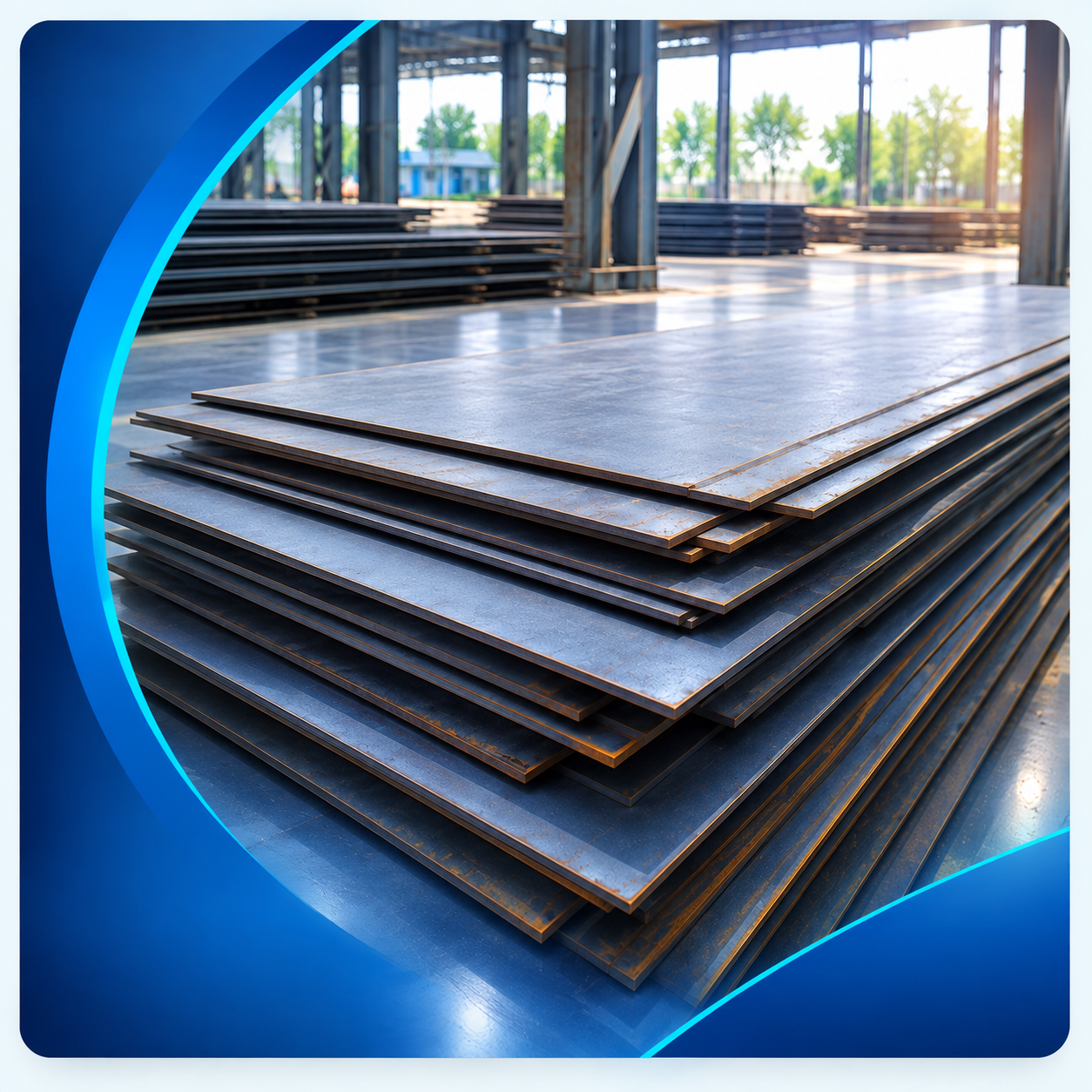
Chiranjiv Steel Centre supplies A516 Grade 70 HIC tested plate (NACE TM0284) for wet H2S service from stockyards at Taloja and Kalamboli, Navi Mumbai. We hold HIC tested heats within our A516 Grade 70 ready stock, and fresh testing to NACE TM0284 comes on order.
HIC tested plate is ASTM A516 Grade 70 plate melted to a restricted chemistry and then proved by test. Sulfur is held far below what the base specification allows, and calcium treatment reshapes the inclusions that remain. Tensile strength, yield strength and elongation stay exactly as the grade specifies.
Every plate ships with an EN 10204:2004 Type 3.1 mill test certificate and the NACE TM0284 test report for its heat.
On this Page
What HIC Testing Adds to A516 Grade 70
Hydrogen-induced cracking needs no applied stress. Wet H2S corrodes the steel surface, atomic hydrogen enters the steel, and it collects at internal discontinuities until the pressure splits the steel along planes parallel to the rolling direction. Cracks on neighbouring planes join up and form steps through the thickness.
Sulfur is what starts it. Sulfur left in the steel rolls out into long, flat manganese sulfide stringers, and each one is a hydrogen trap with a ready-made crack plane. Standard A516 Grade 70 permits 0.025 percent sulfur, which is far too much for sour duty. HIC tested plate is melted well below that and calcium treated, so the inclusions form as globules instead of stringers. A globular inclusion traps less hydrogen and gives a crack nowhere flat to follow.
Tensile strength, yield strength and elongation are unchanged. HIC ordering buys cleanliness, not different mechanical properties.
Supplementary Chemistry for HIC Tested Plate
ASTM A516 Grade 70 chemical composition bands carbon by thickness and caps sulfur and phosphorus at 0.025 percent each. HIC tested heats are bought far tighter than that. The table lists only what changes.
| Element or Practice | Typical HIC Practice | Purpose |
|---|---|---|
| Sulfur | 0.002% maximum, commonly 0.001% | Removes the manganese sulfide stringers that seed cracks |
| Phosphorus | 0.010% typical | Limits centreline segregation through the thickness |
| Calcium treatment | Calcium added in controlled ratio to the sulfur that remains | Turns sulfide stringers into globular inclusions |
| Steelmaking route | Vacuum degassed, ladle refined | Lowers dissolved gas content, raises cleanliness |
These are ordering figures agreed with the mill, not fixed specification limits. The certified sulfur and phosphorus figures for each heat appear on its mill test certificate.
Need HIC tested plate for sour service?
NACE TM0284 HIC Testing Explained
NACE TM0284 is the test method for hydrogen-induced cracking. Specimens are cut from the heat, left unstressed, and held in an H2S saturated solution. They are then sectioned, polished and examined for cracks.
Plate is tested in Solution A, which is the most severe of the solutions in the standard and the normal choice for pressure vessel plate. Exposure is 96 hours at 25 ± 3 °C. Specimens are 100 mm long by 20 mm wide, at full plate thickness up to 30 mm.
Above 30 mm the specimens are staggered through the section so the mid-thickness, where segregation concentrates, is covered. Up to 88 mm the set is three specimens. Above 88 mm the standard calls for five or more, so testing costs more at the heavy end of our range.
HIC Acceptance Criteria: CLR, CTR and CSR
Three ratios are calculated from the measured cracks and reported as percentages.
- Crack Length Ratio (CLR): the sum of all crack lengths, divided by the section width.
- Crack Thickness Ratio (CTR): the sum of all crack thicknesses, divided by the specimen thickness.
- Crack Sensitivity Ratio (CSR): each crack’s length multiplied by its own thickness, added together, divided by section width times specimen thickness.
The limits come from your project specification. The set almost always used is CLR 15 percent, CTR 5 percent and CSR 2 percent maximum, referenced through NACE MR0175/ISO 15156.
The limits are normally judged on the average of the three sections of each specimen. They can also be judged per single section or across the whole test set, and the same plate can pass on one basis and fail on another, so name the basis on the order.
NACE TM0284 vs TM0177 vs MR0175 / MR0103
Four standards get quoted together on sour service enquiries and only one is an HIC test.
| Standard | What it is |
|---|---|
| NACE TM0284 | The HIC test method. Unstressed specimens, CLR, CTR and CSR reported. |
| NACE TM0177 | The sulfide stress cracking test. Specimens are stressed, in tension, as a bent beam, as a C-ring or as a double cantilever beam. |
| NACE MR0175/ISO 15156 | Materials requirements for upstream oil and gas production. Not a test method. It covers HIC and supplies the CLR, CTR and CSR limits. |
| NACE MR0103/ISO 17945 | Materials requirements for refinery process equipment. Not a test method. It covers sulfide stress cracking, and HIC sits outside its scope. |
What to Specify on Your Purchase Order
Six lines cover the test and certification scope of an A516 NACE HIC plate order.
- Specification and grade: ASTM A516/A516M Grade 70, dual certified to ASME SA-516 Grade 70 where required.
- Delivery condition: as-rolled or normalized.
- HIC test method and solution: NACE TM0284, Solution A.
- Acceptance limits: CLR, CTR and CSR values, plus the basis they are judged on.
- Test frequency: one test set per heat, or per heat and thickness.
- Certification: EN 10204:2004 Type 3.1 with the HIC test report.
Request a quote with HIC test requirements. Send thickness, quantity and test scope, and we will confirm availability against HIC tested heats in stock.
Available Configurations
HIC tested plate is itself a configuration of A516 Grade 70, and several further choices sit inside one order line.
| Configuration | Options |
|---|---|
| Source of HIC result | Tested heats held in stock, or fresh testing to NACE TM0284 on order |
| Delivery condition | As-rolled from ready stock; normalized (Gr 70N) on order, mandatory above 40 mm |
| HIC test solution | NACE TM0284 Solution A, stated on the report |
| Acceptance basis | Per specimen average, per single section, or per test set, as the order names |
| Certification | EN 10204:2004 Type 3.1 with HIC test report |
| Processing | Cut to size, blanks and circles for dished ends and tube sheets |
| Order size | No minimum order quantity |
Delivery condition is the choice buyers query most. Our ready stock, including the HIC tested heats, is as-rolled. Many project specifications ask for normalized plate in sour service, so state the delivery condition on the order rather than assuming it, and we will confirm whether a stock heat suits the drawing. That is what the N in SA 516 Gr 70N HIC plate refers to.
A516 Grade 70 HIC Plate Sour Service Applications
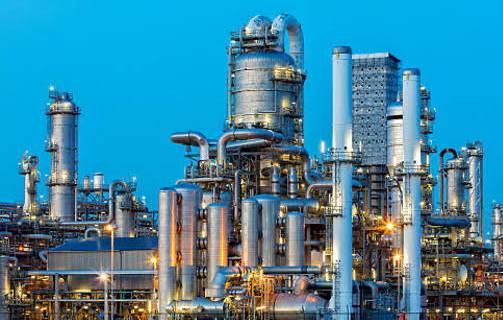
A516 Grade 70 HIC tested plate goes into pressure vessels, absorbers, separators and drums wherever the process stream carries both water and hydrogen sulfide. Wet H2S exposure turns up more often in oil and gas duty than in any other application we supply, and four service areas account for most of it: refinery and petrochemical vessels, amine and scrubbing units, upstream separation equipment, and gas processing plants.
Refinery and Petrochemical Pressure Vessels
Hydrotreater separators, sour water strippers and knock-out drums run with wet H2S in continuous contact with the shell. HIC resistant steel plate is specified for shells and heads on this equipment, and refinery specifications often call for ultrasonic examination as well.

Amine Treating and H2S Scrubbing Units
Amine absorbers and regenerators concentrate hydrogen sulfide by design, which puts them among the most demanding services on this list. Rich amine lines and regenerator overhead vessels stay wet and sour throughout, so vessels in this duty are built from HIC tested plate and given post-weld heat treatment as a matter of course.

Upstream Separation Equipment
Production separators, test separators and glycol contactors on sour fields are built to project specifications that call for HIC tested heats. The HIC report travels with the plate into the fabricator’s material records, and the fabricator carries the sour service qualification from there.

Gas Processing and Fertiliser Feed Gas
Inlet separators, filter coalescers and sour gas treatment vessels handle feed gas before sulfur removal is complete. Ammonia plant gas treatment sections in fertiliser complexes run the same duty, and the same material is often ordered as HIC tested boiler quality plate for adjacent steam equipment.
Documentation and Dispatch
Documentation is what a sour service buyer screens first, so every consignment carries a full set. Each plate ships with an EN 10204:2004 Type 3.1 mill test certificate stating heat chemistry, mechanical results and delivery condition, together with the NACE TM0284 test report giving CLR, CTR and CSR values for that heat. Plates are stencilled with grade, heat number and plate identifier. Stock sizes are dispatched from Taloja or Kalamboli within 2 to 3 working days, with delivery across India. Full plates ship with waterproof packing and steel strapping. Cut pieces, blanks and circles ship in wooden cases or crates.
A516 Grade 70 HIC Plate Price
A516 Grade 70 HIC plate price sits at the upper end of the ₹75 to ₹120 per kg band for the grade, ex-works Mumbai. The premium over standard as-rolled plate pays for a heat melted to restricted chemistry and then qualified by a destructive test. Final price depends on thickness, plate size, quantity, testing scope and certification level. Fresh HIC testing on order carries the test cost on top of the plate. Request a quote for current pricing.
A516 Grade 70 HIC Tested Plate FAQs
What is SA 516 Gr 70N HIC material?
SA 516 Gr 70N HIC plate is ASME SA-516 Grade 70 supplied in the normalized condition and HIC tested to NACE TM0284. The N is trade shorthand for the normalizing heat treatment, not a separate grade. Normalizing is mandatory above 40 mm and optional below it. It is also called for below 40 mm when the order specifies notch toughness testing, unless the purchaser states otherwise.
Do you supply HIC tested plate from stock?
Yes. We hold HIC tested heats within our 3 mm to 20 mm A516 Grade 70 ready stock at Taloja and Kalamboli. Availability is confirmed heat by heat against the HIC report. Plate up to 100 mm thick is supplied on order with fresh HIC testing.
What does the HIC test report show?
The report gives crack length ratio, crack thickness ratio and crack sensitivity ratio for each section, for each specimen as the average of its sections, and for the whole test set as the overall average. It also records the test solution, the exposure time and temperature, and the heat number tested. Results are recorded against the acceptance limits agreed on the order.
What makes A516 Grade 70 plate HIC resistant?
Two things: very low sulfur and calcium treatment for inclusion shape control. Sulfur is dropped to around 0.002 percent or lower, and calcium is added in controlled ratio to the sulfur that remains, so inclusions form as globules rather than stringers. Low hardness by itself does not deliver HIC resistance, which is a common misreading of sour service requirements.
Is impact testing included with A516 Grade 70 HIC plate?
No. Charpy V-notch testing is a supplementary requirement under ASTM A20/A20M and is ordered separately from HIC testing. A project can call for both. Impact tested plate falls outside our supply programme, and we confirm that at enquiry stage where a project asks for both.
